By Drake Miller – Senior Content Manager and Academic Strategy Consultant
The modern educational landscape has undergone a seismic shift. The traditional mahogany-desk-and-chalkboard setup has been replaced by the glow of LED screens, endless Zoom links, and 24/7 access to Learning Management Systems (LMS) like Canvas or Blackboard. While the “hyper-digital” era offers unparalleled access to information, it has birthed a new, invisible epidemic: Digital Academic Burnout.
For high school students eyeing the Ivy League and university students navigating complex degrees, the pressure to be “always on” is relentless. When your classroom, your social life, and your study resources all exist on the same 13-inch laptop, the boundaries of rest disappear. This guide explores the mechanics of burnout in the digital age and provides actionable strategies to reclaim your mental health while maintaining academic excellence.
1. Defining the Beast: What is Digital Burnout?
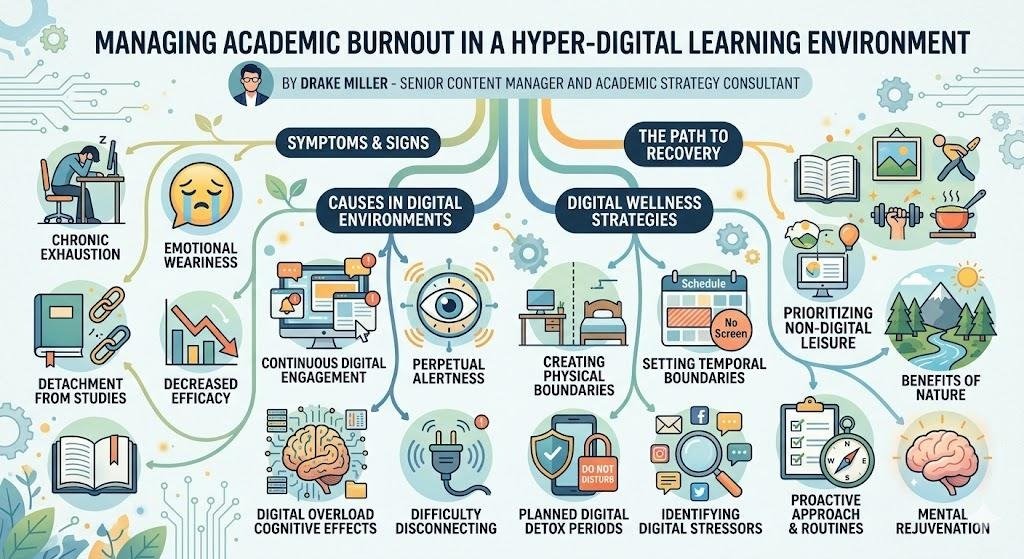
Academic burnout isn’t just “being tired.” It is a state of emotional, physical, and mental exhaustion caused by prolonged stress. In a digital environment, this is exacerbated by:
- Cognitive Overload: The constant switching between tabs, notifications, and research papers.
- Zoom Fatigue: The intense neurological exhaustion from processing non-verbal cues over video calls.
- The “Notification Trap”: The anxiety triggered by the “ping” of a new assignment or a professor’s email at 9:00 PM.
For students tackling high-pressure STEM subjects, the workload can become particularly overwhelming. Seeking specialized biology assignment help can alleviate some of this cognitive load, allowing you to focus on core concepts rather than getting bogged down in dense lab reports or complex data analysis.
2. The Psychology of the “Always-On” Culture
In the USA, the competitive nature of high school and college education often equates “busyness” with “productivity.” Digital tools have weaponized this. When you can access your coursework from your phone in bed, your brain never truly enters a “parasympathetic” state—the state required for recovery.
To combat this, students often turn to external support. Whether it’s seeking a mentor or looking for specialized assistance like Myassignmenthelp.com, recognizing that you cannot do everything alone is the first step toward recovery. Often, the smartest move for a student’s mental health is to delegate, and choosing to do my assignment online through a reliable platform can provide the breathing room needed to reset and avoid total exhaustion.
3. Top Strategies for Managing Burnout
- Establish “Digital Sunset” Protocols: The blue light emitted by screens suppresses melatonin. Disconnect from all academic platforms at least 90 minutes before sleep to improve REM cycles.
- The Pomodoro Technique 2.0: Work for 25 minutes, then take a 5-minute non-digital break. Look out a window or stretch; do not check your phone.
- Curate Your Digital Workspace: Use browser extensions to block distracting sites like YouTube or Reddit during study hours. Treat your digital desktop with the same organization you would a physical one.
4. Bridging the Gap with Professional Support
One of the primary drivers of burnout is “Imposter Syndrome”—the feeling that you aren’t doing enough compared to your peers. When the workload becomes a threat to your mental health, leveraging academic resources becomes a necessity. Services provided by Myassignmenthelp.com act as a safety net for students drowning in complex rubrics and tight deadlines. By outsourcing the stress of formatting, citations, or initial research, students can focus on core concepts without the paralyzing fear of failure.
5. The Role of Physicality in a Virtual World
Digital burnout is physically stored in the body. Use the 20-20-20 Rule: Every 20 minutes, look at something 20 feet away for 20 seconds to reduce ocular strain. Additionally, high school and college students should aim for at least 30 minutes of physical activity daily to flush out cortisol.
6. Navigating Social Media Envy
Social media is often a “highlight reel” of academic success. Seeing a peer post about a 4.0 GPA while you are struggling with a basic essay can trigger a spiral. Remember: most digital personas are curated. Limit time on LinkedIn and Instagram during midterms and finals.
7. Identifying the “Point of No Return”
How do you know if you’re just stressed or truly burnt out? Look for these red flags:
- Increased Irritability: Snapping at friends or family over minor things.
- Lack of Motivation: Even subjects you used to love feel like a chore.
- Physical Ailments: Frequent headaches or a weakened immune system.
- Escapism: Spending hours mindlessly scrolling to “numb” the thought of schoolwork.
8. Creating a Sustainable Academic Routine
The goal is to work in a way that is sustainable for a four-year degree.
- Batching Tasks: Handle all emails at once, then all reading, then all writing.
- Analog Planning: Use a physical paper planner for a tactile sense of achievement.
- Self-Compassion: Forgive yourself for “unproductive” days. Recovery is part of the work.
Frequently Asked Questions
Q.1 Can Agentic AI tools help reduce academic burnout or do they make it worse?
It’s a double-edged sword. While Agentic AI can automate tedious tasks like formatting or initial brainstorming, the constant “oversight” of these tools can lead to cognitive fatigue. The key is using AI as a collaborator rather than an extra set of notifications to manage. Setting boundaries on when you use AI assistance is crucial for maintaining your own mental rhythm.
Q.2 What is the “20-20-20 Rule” mentioned for digital eye strain?
This is a simple physiological hack for students glued to screens. Every 20 minutes, look at something 20 feet away for at least 20 seconds. This allows your ocular muscles to relax and resets your focus, which can significantly lower the “physical” sensation of burnout and headaches during long study sessions.
Q.3 How do I tell my parents or professors that I’m experiencing digital burnout?
Be data-driven. Instead of saying “I’m tired,” explain the symptoms: “I’m experiencing cognitive overload and tech-fatigue that is affecting my ability to retain information.” Propose a solution, such as a temporary reduction in extracurricular digital commitments or using professional resources to manage a particularly heavy semester.
Conclusion: You Are More Than Your GPA
In the hyper-competitive USA education system, your value is not defined by your output. Managing academic burnout requires a radical act of self-preservation: setting boundaries. Whether that means turning off notifications, or simply closing your laptop for a walk, remember that your mental health is the foundation of your future success.
About the Author:
Drake Miller is a Senior Content Manager and Academic Strategy Consultant with over 12 years of experience in the higher education sector. He specializes in digital content strategy and the ethical integration of technology into student workflows to enhance academic integrity and success.